Wednesday, February 10, 2010

Apply Now for the 2010-2011 Global Citizen Corps Leadership Program!


The 2010-2011 Global Citizen Corps Leadership Application is now available online!

To apply, visit this website: http://www.globalcitizencorps.org/leadership/apply

The year-long Global Citizen Corps Leadership program works with 500 international youth leaders. Students work together to spread the word about root causes of critical global issues by mobilizing others to make a difference. Over one year, leaders work with Mercy Corps to get the training, knowledge, resources and tools to raise awareness and organize effective local actions that make a global impact.


Leaders will gain skills in four areas: Action Planning, Leadership Development, Multi-Media and Global Issues. With this training, students will have the knowledge and skills to organize powerful actions that address the problems such as global health, hunger, climate change and lack of access to education.


Application deadline is April 30th 2010. This application is available for US Leaders only.

Tuesday, February 9, 2010

Help For Haiti: A Portland student's fundraising effort


Action +Awareness = Impact. That's what Global Citizen Corps is all about, and students who participate in the Leadership program prove this framework is possible.

Dina is a junior at Lincoln High School in Portland, Oregon and a Global Citizen Corps Leader. She was quick to act when she found out about the devastation in Haiti after the earthquake on Tuesday January 12th. On Thursday, two days after the quake, Dina called an emergency meeting with fellow students at school to brainstorm ideas on how to help. They quickly came up with a simple fundraising idea – there was an open slot in the upcoming spirit assembly on Friday, a perfect place to ask the rest of the students for help as well.

Dina spoke to her 1,400 fellow high school students at the assembly, asking them each to donate one dollar to Mercy Corps to support relief efforts in Haiti. She explained how $1 might not seem like much, but if every student donated, it would be huge. To collect funds, students held boxes that said "Help for Haiti" at the assembly and at the doorways to the gymnasium after her speech. Students began carrying these boxes with them to their classrooms, and they set up a donation table at lunch time. On the first day, they were able to collect $325.. The next week they used the same routine of classroom collections and coined their lunchtime donation site "Lunch Change for Haiti".

One week after their initial announcement at the assembly, almost every student had donated a dollar – they raised $1,115 by using the equation Action + Awareness = Impact.

Dina is still working on collecting funds for Haiti and is planning an awareness project for World Water Day on March 22nd. Her fundraising work for Haiti caught national attention, and she is featured in a New York Times article about the success of small group fundraising. Check the article out here: http://www.nytimes.com/2010/02/11/us/11charity.html.

Thank you Dina for making such a positive impact!

Monday, December 7, 2009

GCC World AIDS Day Event


Global Citizen Corps leaders gathered to make some noise on Sunday, December 6th in Portland ,OR. With live music, facts and figures hanging from red balloons and a lot of energy they joined together to build awareness about the global AIDS Pandemic.

Last year 2.7 people became infected worldwide, half of which were young people between the ages of 15 and 24. That breaks down to nearly 6,000 people under 25 infected each day.

Now 33 million people around the world are living with HIV/AIDS and women account for 50 percent of those cases. Although the pandemic is worldwide, Sub-Saharan Africa has been hardest hit—the area accounts for around 10% of the world’s population but it accounts for 67% of all people living with HIV/AIDS.

Due to slightly increased access to improving drugs, the number of people living with HIV/AIDS has risen. Despite this around 2 million people still died of the disease in 2008.

All these scary statistics hung from the red balloons just above visitors’ heads at the Action Center in Portland to help people understand the realities of the AIDS pandemic.


Created with flickr slideshow.

Wednesday, December 2, 2009

Don't Stop Believing


You know how certain songs can take you back to another time and place? For Global Citizen Corp leader Casey Drobnick the song “Don’t Stop Believing” by Journey transports her back to one of her first experiences with the Global Citizen Corps community.

Casey had spent a summer in the Dominican Republic helping to build houses and was struggling to adjust to life back at home. With a new outlook on the world and her place in it she was feeling like her new way of seeing things was not shared by many people—until she found Global Citizen Corps.

After she joined he attended a leadership summit. For Casey the clear highlight of the summit was a two-hour video conference with like minded GCC leaders from Iraq. There she was in the middle of a large group of American kids, chatting and discussing serious issues with kids from Iraq! The Iraqi students sang traditional Kurdish songs and Casey and the other American kids sang “Don’t Stop Believing”—you know: “Just a small town girl, livin’ in a lonely world. She took the midnight train going anywhere!”

After the Global Citizen Corps Summit and the video conference Casey knew that she was not alone in his desire to see real change in the world. There are plenty of people with the same hopes and dreams—they just have to be found. And Global Citizen Corp is a great place to find them.

World AIDS Day


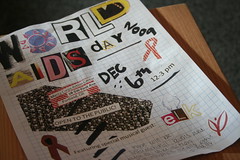
By the end of the day AIDS was completely erased— at least in halls of Wilson High School. Global Citizen Corp Leaders there organized activities for World Aids Day on December 1st. The day is set aside for the world to focus on the continuing spread of the AIDS pandemic and to raise awareness on how to prevent it. To educate their peers GCC leaders wore red and encouraged their classmates to do the same in a display of solidarity with those afflicted. They put up posters around the school with facts and statistics and had a table set up in the hall where they passed out pins, ribbons and informational booklets. On the wall they had a banner that spelled out AIDS with condoms that were meant to be pulled off as a reminder of the simple things that can be done to prevent AIDS. By the end of the day the banner was blank, the table and posters were gone— any trace of AIDS had symbolically disappeared.


Monday, November 23, 2009

Gaza/Portland Student Leader Video Conference


One of the coolest parts about GlobalCitizenCorps is how it provides great ways for student leaders across the world to meet and discuss the issues that affect them. On November 12th GCC Students from Gaza, Palestine met via video conference with fellow leaders in Portland Oregon. They discussed a wide range of topics--everything from food and music to what it's like to live in a war zone. By the end it was clear that both groups, half a world away, shared many of the same passions and goals for the world.

Tuesday, November 17, 2009

A River Ran Through It

What would you do if your city’s livelihood suddenly dried up? Students in Khanaqin, Iraq faced this very question after their city’s river disappeared due to a dam that was built in Iran. They took their voices all the way to the Kurdish Parliament— this is their story.


Until recently agriculture was a main source of income for many of the people of Khanaqin. The climate was dry but the Alwand River flowed through providing the water needed to grow crops. The river also gave the city a source of drinking water, fish, and recreation.


Then a dam was built upstream in Iran. The water stopped flowing and the riverbed and fields became dry. Many of the townspeople lost their livelihood and were forced to flee to find food and a living elsewhere.


Many other towns along the path of the river, which originates deep in the mountains of Iran and empties into the Persian Gulf, also lost their sources of livelihood due to the river’s disappearance.


According to international law it is illegal to monopolize the use of a shared resource that crosses borders. Iran was perhaps unwittingly violating human rights however they seemed unperturbed by the struggles they had induced. The struggling people downstream were angry but did not know what to do.


Created with Admarket's flickrSLiDR.


Enter Omar W, a Global Citizen Corps leader. He and a group of fellow students created a plan to get their story heard and to inspire action. They visited 22 affected villages along the river path and compiled a list of data. In the areas they visited they found that with the river gone, agriculture as the main source of income, had dropped from 95% of people to around 5 % and 43 families had to emigrate from the area due to drought.


Then they gathered more than 100 people and 15 international channels for a conference called “Restoring Life to the Alwand River.” The conference produced a set of ideas on how to proceed. First: Request a meeting with the Kurdish Parliament. Next: Try to get media coverage and political pressure on Iran increased. And finally: consider the construction of their own dam on the Iraqi side of the border to trap any water still trickling and save it for summer.


It is not easy to get a meeting with anyone from the Parliament. Omar and the group made many phone calls requesting some face time and finally a meeting with Dr. Arsalan Baiz, the Vice President of the Parliament was granted with only 12 hours notice. They were a 9 hour car-trip away but packed up quickly and drove all night to the Kurdish Capital making sure their statements and requests were just right on the way.


The ideas from the conference were discussed with Dr. Arsalan along with the possibility of securing annual water ratios and potential compensation for the affected areas. The Vice President thanked the group and promised to

take their issues before the entire parliament.


Omar and those who joined him for the cause left very proud of all they had been able to accomplish. They felt a new sense of empowerment—that they could really make a difference.